Does mobile detailing use less water than a car wash?
October 23, 2026 · 9 min read · Frogman Detailing
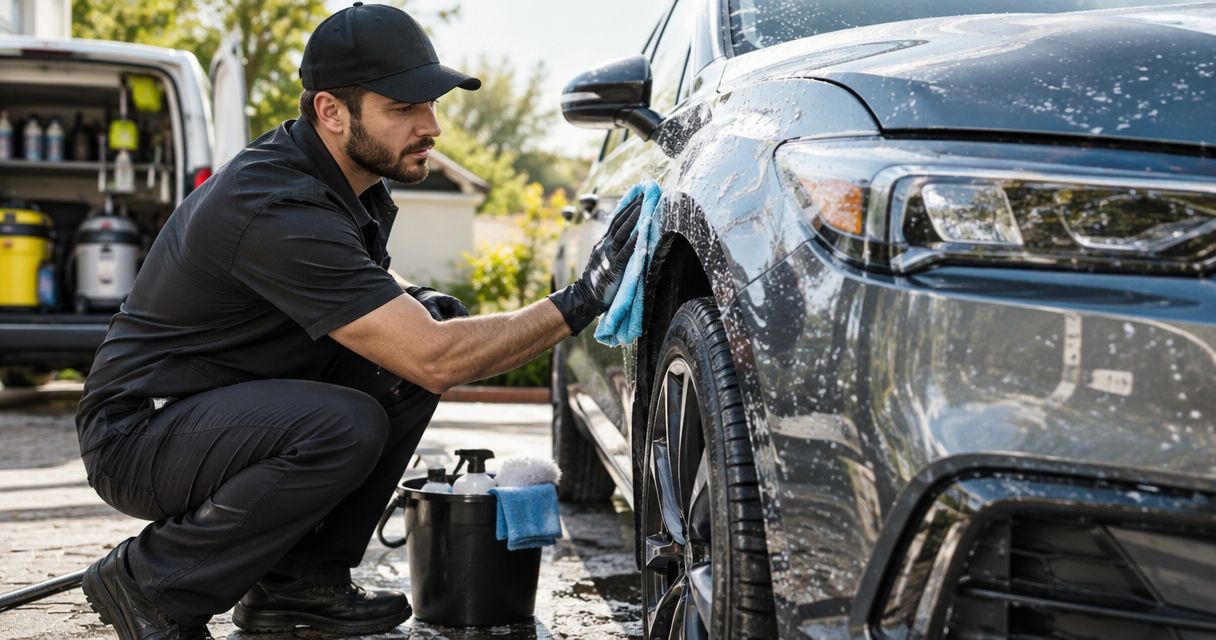
Mobile detailing can use less water than a car wash, but the cleaning method decides that, not the fact that the detailer comes to you. A rinseless wash can avoid the running-water rinse used in conventional washing, while a commercial car wash that reclaims water can reduce its freshwater demand. Compare the same cleaning job and separate freshwater use from total water circulated.
TL;DR
- Mobile detailing water usage vs car wash depends on wash method, vehicle condition, and water reclamation.
- Rinseless washing avoids a running-water rinse, but heavy grit still needs safe removal.
- Commercial car washes can reclaim water. Total spray volume is not the same as freshwater consumption.
- Frogman Detailing is best for Oklahoma City customers who want mobile detailing in their driveway.
Does mobile detailing use less water than a car wash?
Sometimes. Mobile detailing is a service location, not a water-saving method. A detailer using a controlled rinseless process does a different job from someone leaving a hose running between panels. Both services can happen in a driveway.
The same distinction applies to car washes. A facility that treats and reuses wash water has a different freshwater requirement from one using fresh water throughout. You cannot settle the comparison by watching how much water hits the car.
| Cleaning option | Best for | Water-use advantage | Limitation |
|---|---|---|---|
| Rinseless mobile wash | Routine cleaning when the soil suits the method | Eliminates a separate running-water rinse | Heavy contamination can require pre-rinsing |
| Waterless cleaning | Light dust and suitable spot cleaning | Avoids a conventional hose rinse | Not the right starting point for caked mud |
| Conventional mobile wash | Vehicles needing a thorough rinse | Water flow can be controlled between tasks | Usage depends on equipment and operator habits |
| Commercial wash with reclamation | Drivers comparing freshwater demand | Reuses some process water | Reclaimed water does not mean no freshwater use |
| Open-hose driveway wash | Owners doing their own conventional wash | A shutoff nozzle stops unnecessary flow | A running hose wastes water between cleaning steps |
Frogman Detailing provides mobile car, truck, and motorcycle detailing throughout the Oklahoma City metro, including Edmond and Arcadia. The service comes to your driveway. That describes the convenience, not a measured water-saving claim.
Why the water comparison matters
For a useful 2026 comparison, start with what you want cleaned. An exterior maintenance wash and a full detail with carpet extraction are not equivalent jobs. Comparing their totals without separating the work tells you very little.
Water use also has more than one meaning. Freshwater drawn from a supply, water sprayed during cleaning, and wastewater leaving the work area answer different questions. A conservation claim should say which one it measures.
Use these distinctions when you ask questions:
- Freshwater input: Water newly drawn from a tap or another supply.
- Reclaimed water: Previously used wash water treated for reuse within a system.
- Wastewater: Used cleaning water that needs appropriate handling.
Less freshwater use is a useful goal. It does not excuse dragging grit across paint or letting dirty wash water run wherever gravity takes it.
Rinseless washing: less rinsing, not less care
Rinseless washing uses a product designed to clean without a separate hose rinse. The operator applies the cleaning solution, removes soil with suitable wash media, and dries the surface according to the product instructions.
Best for: routine maintenance when the vehicle's contamination suits the process. Its practical advantage is avoiding a continuous rinse stream. Its limitation is that bonded grit, packed mud, and dirty wheel wells can call for additional cleaning before paint contact.
A rinseless wash is not permission to scrub a dirty panel harder. Clean wash media and controlled contact matter. Once a towel or wash mitt carries grit, that grit becomes part of whatever touches the next panel.
Ask whether the detailer inspects the vehicle before choosing the method. A sensible process changes with the condition of the car. The method serves the paint, not the other way around.
Waterless cleaning: useful within its limits
Waterless products are applied directly to a surface and wiped away according to their instructions. The term describes the cleaning process. It does not prove that no water was involved in making the product or laundering the towels.
Best for: light dust or isolated cleaning where the product permits it. Avoiding a hose rinse is the benefit. Limited suitability for heavily soiled surfaces is the drawback.
For a 2026 booking, ask what the operator means by waterless. Is it a light exterior wipe-down, a maintenance service, or part of a larger detail? Those are different scopes, even if the same word appears in the description.
If your vehicle has visible grit or caked dirt, do not make minimum water use the only instruction. Read the guide to whether waterless car washing is safe for your paint before treating the method as a fit for every dirty vehicle.
Conventional washing and reclaimed water
A conventional wash uses water to wet, clean, and rinse the vehicle. Mobile operators and fixed-site washes can both use variations of that process. Equipment, shutoff habits, and the amount of cleaning all affect the result.
Best for: vehicles that need loose contamination flushed away before contact cleaning. The advantage is physical rinsing. The limitation is that unnecessary spraying adds water without adding useful cleaning.
A commercial reclamation system collects and treats used water for reuse. That means total water moving through the wash can exceed the amount of fresh water entering it. A large-looking spray is not proof of large freshwater consumption.
Reclamation does not make every commercial wash identical. Ask what the facility measures and which stages use reclaimed water. Likewise, a mobile operator carrying a water tank has shown where the water comes from, not how much the job consumes.
Why water usage varies
The biggest drivers are practical. Your vehicle's condition, the requested work, and the chosen process matter more than whether the business has a building.
- Soil level: Light dust and packed mud require different preparation. Heavy contamination needs safe removal before wiping.
- Vehicle size: A truck presents different surfaces and wheel-well access from a motorcycle. Compare similar vehicles.
- Service scope: Exterior washing, wheel cleaning, and interior extraction involve different tasks. Keep the comparison like for like.
- Wash method: Rinseless, waterless, and conventional washing use water differently. A service label alone does not identify the method.
- Equipment and habits: Flow control and shutting water off between tasks prevent unnecessary use. Tank capacity alone says nothing about efficiency.
- Water reclamation: Reusing treated process water changes freshwater demand. Separate that from the amount sprayed during cleaning.
For an honest 2026 estimate, describe the actual vehicle. Mention mud, wheels, truck beds, and interior cleaning rather than asking for a generic total. A clean commuter car is not a work truck wearing half the jobsite.
How to compare two services fairly
You do not need an engineering report. You need both providers answering the same question. Use this sequence before treating a water-saving claim as a reason to book.
- Match the job. Compare the same vehicle and the same cleaning scope. Keep interior extraction separate from an exterior-only comparison.
- Name the method. Ask whether the service uses conventional rinsing, rinseless washing, waterless cleaning, or a combination.
- Define the water. Ask whether the figure describes fresh water drawn, total process water, or tank capacity.
- Check the runoff. Ask how used wash water is handled at the work location. Do not assume a driveway provides containment.
- Check the paint. Ask how the operator removes loose grit before contact. Saving water should not require accepting poor cleaning technique.
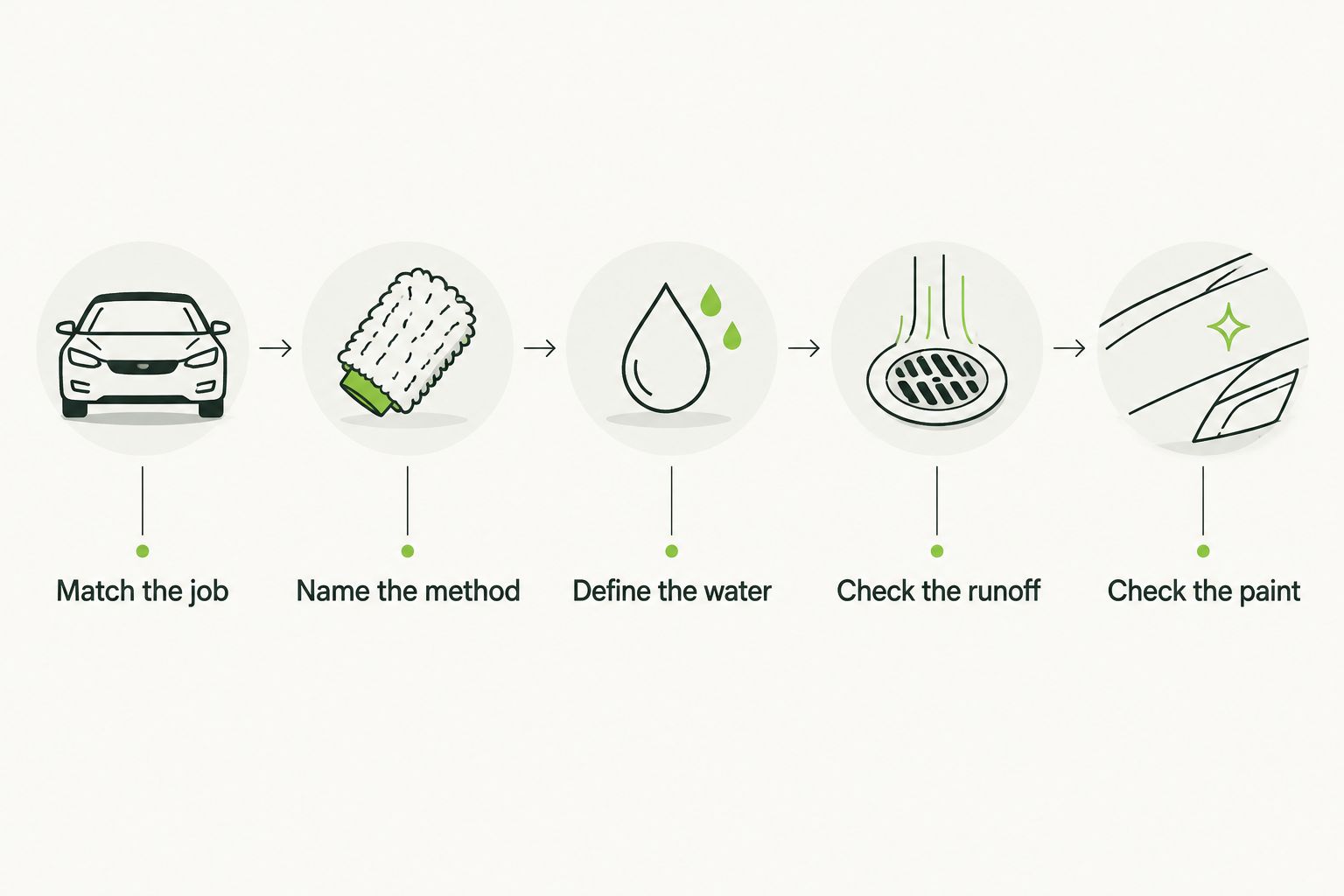
Compare the same cleaning job before comparing water claims.
Keep the answers together. A provider discussing exterior wash water is not contradicting another provider discussing a full interior and exterior service. They are answering different questions, which is exactly the problem this checklist prevents.
Does a mobile detailer's water tank show how much water gets used?
Tank capacity is not water consumption. A tank tells you how much water the equipment can carry, not how much leaves it during your appointment.
A self-contained setup can remove the need to use your outdoor faucet. It does not automatically reduce the water required for cleaning. Ask about the process and actual job scope instead of using tank size as an efficiency score.
This distinction matters when booking Frogman Detailing mobile detailing or any other driveway service. Confirm the water-access arrangements directly before the appointment rather than assuming that mobile means self-contained.
Is a low-water wash always better for your paint?
Low water use does not guarantee safe paint contact. The condition of the surface, the cleaning product, and the way contamination is removed all matter.
Choose a method that fits the dirt. If the vehicle needs pre-rinsing, skipping it solely to make the water total smaller is the wrong trade. You are trying to clean the finish, not win an argument with a bucket.
The same rule applies in 2026 regardless of the service label: inspect first, choose the process second. Neither a pressure washer nor a bottle marked waterless makes up for poor technique.
Does using less water prevent runoff problems?
Less water does not automatically mean properly handled wastewater. Wash water can carry removed dirt, cleaning products, and vehicle residue. Where it goes still matters.
Before driveway work, ask about collection, drainage, and the requirements that apply at your location. Do not assume runoff is harmless because the wash uses a small amount of water or a product described as biodegradable.
For apartment or shared-property parking, confirm permission as well. Access to a parking space and permission to wash a vehicle there are separate issues.
FAQ
Does mobile detailing always use less water than an automatic car wash?
No. Mobile detailing water use depends on the cleaning method and service scope, while an automatic wash can reduce freshwater demand through reclamation. Compare equivalent work and the same water-use measure.
What's the difference between rinseless and waterless washing?
Rinseless washing uses a cleaning solution without a separate running-water rinse, while waterless cleaning generally uses a spray-and-wipe process. Follow the product instructions and choose a method suited to the contamination.
Can I get a muddy truck cleaned with a waterless wash?
Do not treat a waterless wipe-down as the starting point for caked mud. Have the contamination assessed and removed safely before contact cleaning.
Does reclaimed car wash water mean the wash uses no fresh water?
No. Reclamation means used wash water is treated for reuse, not that the facility uses no fresh water. Ask which water-use measure the operator reports.
Do I need to leave my garden hose out for a mobile detailer?
Confirm water-access requirements with the detailer before the appointment. Mobile service alone does not tell you whether the operator needs your faucet or carries a water supply.
Is Frogman Detailing an option for driveway detailing in Edmond?
Yes. Frogman Detailing provides mobile car, truck, and motorcycle detailing in the Oklahoma City metro, including Edmond and Arcadia. Confirm the cleaning scope and site requirements when arranging service.
One last thing
Ask about the second wash, not just the first. If a low-water service leaves contamination that requires another cleaning, the first job's water total does not describe the whole result.
Your 2026 booking checklist should be simple: the right process for the dirt, clear water-access arrangements, and responsible wastewater handling. Get the vehicle cleaned properly. Counting only what comes out of the hose misses part of the job.
Related guides
Frogman comes to your driveway across the Oklahoma City metro.