Can mobile detailers work on RVs and boats?
October 20, 2026 · 10 min read · Frogman Detailing
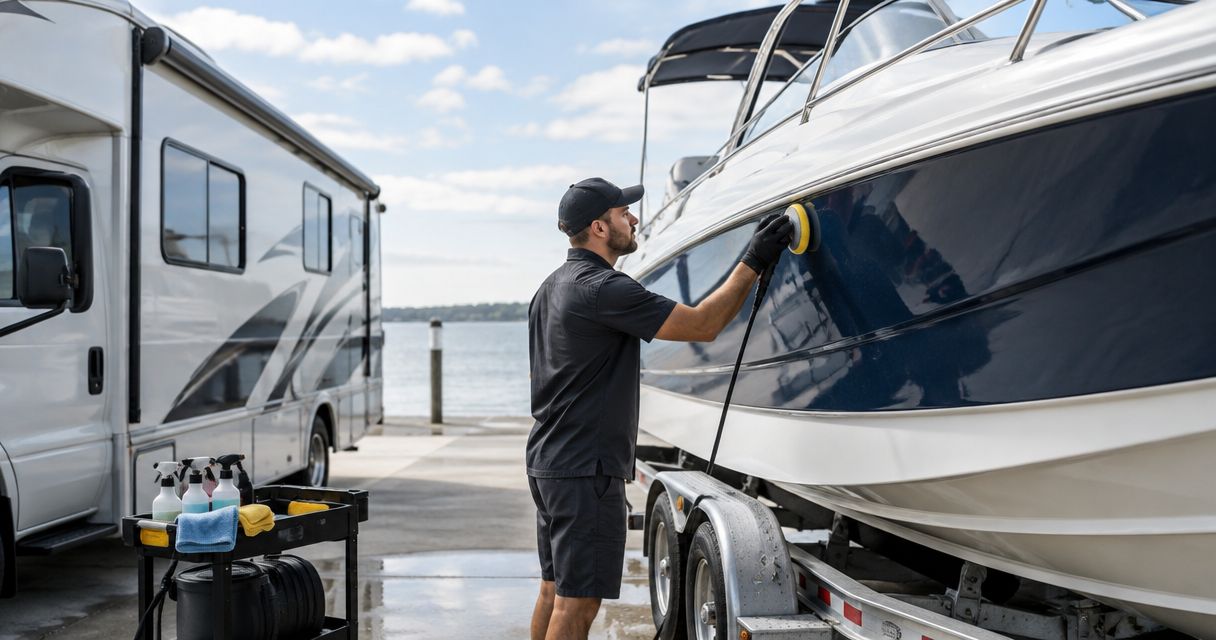
Yes. Mobile detailers can work on RVs and boats when they have the equipment, surface knowledge, and safe access the job requires. Car-detailing experience alone does not establish that capability, and a cleaning appointment does not automatically include roof work, oxidation removal, or underwater hull cleaning.
TL;DR
- RV and boat mobile detailers need experience with the actual surfaces, not just automotive paint.
- Confirm roof access, wash-water handling, utilities, and property permission before booking.
- Separate routine cleaning from oxidation removal, repairs, and underwater hull work.
- Frogman Detailing provides mobile car, truck, and motorcycle detailing. Ask directly about RV or boat work.
Can mobile detailers work on RVs and boats?
Yes, but choose the detailer for the vehicle and the job, not just the convenience of a driveway appointment. An RV combines several materials across a large, sometimes difficult-to-reach surface. A boat adds marine finishes, deck hardware, and access questions that a car wash does not cover.
Use this comparison when discussing a 2026 appointment. These are job categories to confirm, not a promise that every mobile detailer performs them.
| Job | Best for | Main advantage | Limitation to confirm |
|---|---|---|---|
| RV exterior cleaning | Owners dealing with ordinary exterior dirt | Cleaning where the RV is parked avoids a separate trip | Roof access, decals, seals, and wash-water handling need separate attention |
| RV interior detailing | Owners with dirty floors, seats, and living areas | Work can focus on the surfaces you actually use | Appliance servicing, leaks, and repairs are different jobs |
| Boat topside detailing | Owners needing accessible deck and above-water surface cleaning | Work can target exposed surfaces and seating | Hull access depends on whether the boat is afloat, trailered, or supported ashore |
| Oxidation removal | Owners with confirmed surface oxidation | Addresses deterioration that washing alone does not remove | Requires assessment of the finish and a suitable correction method |
For driveway-based automotive care, Frogman Detailing serves car, truck, and motorcycle owners throughout the Oklahoma City metro, including Edmond and Arcadia. Confirm RV or boat scope directly rather than treating an automotive service listing as approval for either job.
Why this matters before you book
A clean vehicle and a corrected finish are different outcomes. Washing removes surface dirt. It does not repair cracked sealant, restore torn upholstery, or establish that a chalky finish is safe to polish.
That distinction matters when you describe the problem. Tell the detailer whether you want road grime removed, the cabin cleaned, or a dull exterior assessed. Otherwise, you and the person doing the work can agree on the word detailing while picturing different jobs.
Book the result you need, with the exclusions written down. A clear scope is more useful than a package name that leaves you guessing.
RV detailing: check the roof, finish, and living area separately
Best for: Owners who can provide access around a parked RV and identify the areas needing attention. The practical advantage is avoiding a separate trip with a large vehicle. The limitation is that ground-level cleaning does not establish safe access to the roof or upper panels.
The roof is a separate access decision
Do not assume an RV roof is walkable. Follow the vehicle manufacturer's instructions for the roof material, permitted access, and cleaning products. An attached ladder is not a substitute for those instructions.
Ask whether roof cleaning is included, how the detailer will reach it, and which areas will remain untouched. Report known leaks or damaged sealant before work starts. Cleaning is not a roof inspection or a leak repair.
Identify what covers the exterior
An RV can have painted panels, fiberglass surfaces, decals, plastic trim, and different window materials. The right treatment depends on the surface in front of the detailer, not simply the fact that it belongs to an RV.
Flag peeling graphics, loose trim, existing cracks, and previous repairs. Ask how those areas will be handled. A sensible plan treats existing damage as a limit, not an invitation to scrub harder.
Define the interior boundary
An RV interior is also a living space. State whether you want the cab, sleeping area, seating, flooring, storage compartments, or bathroom cleaned. Empty personal belongings from the areas you expect the detailer to reach.
Do not treat appliance servicing, plumbing work, electrical repairs, or mold remediation as ordinary detailing. If a smell comes from a leak or another ongoing source, cleaning the visible surface does not solve the source.
Boat detailing: location determines what can be reached
Best for: Owners who can describe the boat's finish, condition, and working location. The advantage is targeted cleaning without automatically moving the boat elsewhere. The limitation is that a dockside appointment does not provide the same access as a boat positioned safely ashore.
A boat on a trailer
A trailer can make much of the exterior accessible, but bunks and rollers still cover contact areas. Tell the detailer where the boat sits and send pictures showing the trailer, hull, and surrounding space.
Do not move supports or crawl under an inadequately supported boat to make a cleaning job possible. If access requires lifting or repositioning, arrange that through someone qualified to do it. Detailing equipment is not boat-lifting equipment.
A boat in the water
Dockside access limits which surfaces a detailer can safely reach. Underwater hull cleaning is a separate scope, not something to assume comes with washing the deck and seating.
Ask the marina or property manager whether outside contractors and the proposed cleaning methods are permitted. Confirm wash-water requirements before scheduling. Soap disappearing over the edge is not a runoff plan.
Marine surfaces need their own instructions
Gelcoat, painted surfaces, clear enclosures, vinyl seating, and nonskid decking do not all call for the same treatment. Follow the applicable manufacturer's care guidance and have the detailer identify the surfaces before choosing products or polishing methods.
Keep grip in mind, too. Ask which products will be used on walking surfaces and controls. A shiny deck is not an improvement if the treatment makes footing less secure.
Why RV and boat detailing requirements vary
The size of the vehicle matters, but size alone does not explain the job. For a 2026 booking, these factors give the detailer useful information before anyone agrees to the work:
- Surface materials: Paint, gelcoat, roof membranes, graphics, clear panels, and upholstery require material-specific care.
- Condition: Ordinary dirt, embedded contamination, oxidation, and physical damage are different problems. Describe what you see without assuming the treatment.
- Reach and access: Upper RV panels, roofs, trailer contact points, and water-facing hull areas create different working limits.
- Working location: A driveway, storage lot, campground, and marina each require their own permission and site arrangements.
- Included work: Exterior washing, interior cleaning, polishing, and protective treatments need explicit boundaries. One does not automatically include another.
Good photos help explain each factor. Include an overall view, the problem surface, and the space around the vehicle. A close-up of a stain tells the detailer very little about whether equipment can reach it.
What should you send before requesting an appointment?
Use this sequence for a 2026 inquiry. It gives the detailer enough context to discuss the job without pretending a message replaces an inspection.
- Identify surfaces. Send the make and model, plus the finish or roof material if you know it. Use the owner's manual rather than guessing.
- Show condition. Photograph dirt, dullness, stains, damaged graphics, loose seals, and other areas that need special handling. Include a wider view for context.
- Confirm access. Describe the parking surface, nearby obstacles, overhead clearance, and whether the boat is afloat or ashore. Include the space needed to work around it.
- Set the scope. List the areas you want cleaned and the outcome you expect. Ask the detailer to identify exclusions and work requiring further assessment.
- Agree on logistics. Confirm property permission, utilities, wash-water handling, weather arrangements, and how the finished job will be reviewed.
That sequence separates the surface problem from the site problem. Both need an answer before the appointment makes sense.

Confirm the vehicle and the working site before agreeing to the job.
Keep the agreed scope with your appointment details. If the detailer finds a different material or more serious damage on arrival, discuss the revised approach before work continues.
Can a mobile detailer work at a storage lot or marina?
Yes, if the property permits the work and the site supports the proposed method. Your right to park there does not automatically include permission to bring in an outside contractor or discharge wash water.
For a 2026 storage-lot or marina appointment, ask the property manager about contractor access, working hours, cleaning restrictions, and required documentation. Then give those requirements to the detailer before booking.
Shared residential properties raise similar permission questions. The guide to getting mobile detailing approved by your HOA or complex covers that part of the planning.
Does RV or boat detailing include oxidation removal?
No, not automatically. Oxidation removal is a separate surface-correction task, and the detailer needs to assess the material and condition before choosing a method.
Dullness is a symptom, not a diagnosis. Ask whether the proposed work is cleaning, polishing, or applying protection, and what each step is expected to change. Do not accept permanent-repair language for work that only improves appearance.
Do you need to provide water and electricity?
Confirm water and electricity directly with the provider. Mobile describes where the service happens; it does not tell you what equipment or supplies arrive with the detailer.
Describe the usable connections and their location, not just whether the property has utilities somewhere. Also agree on how wash water will be handled. A hose connection answers only part of the setup question.
What to check before the detailer starts
Walk around the RV or boat together when practical. Point out existing damage, loose components, sensitive equipment, and areas excluded from the work. Agree on where the detailer can safely work without moving the vehicle or its supports.
Ask what happens if the surface does not respond as expected. The right next step is to stop and discuss the condition, not keep increasing pressure or abrasiveness until something changes.
For your 2026 appointment, make the finish review part of the plan. Look at the agreed areas together afterward and distinguish remaining damage from missed cleaning. Those are different conversations.
FAQ
Can any mobile car detailer clean my RV?
No. Confirm experience with your RV's materials, safe access, and the specific work you need. Car-detailing experience alone does not establish roof-cleaning or RV finish-correction capability.
Can a mobile detailer clean my boat while it is in the water?
Accessible above-water areas can be detailed if the provider and marina permit the work. Underwater hull cleaning requires a separate agreement and suitable capability.
Will an RV detail fix a leaking roof?
No. Cleaning does not repair a leaking roof. Report leaks and damaged sealant before work starts, and arrange appropriate repair work separately.
Does boat detailing include polishing the hull?
Not automatically. Confirm whether hull polishing is included, which surfaces can be reached, and whether the finish needs assessment before correction.
Can a detailer use car products on my boat?
Product suitability depends on the actual surface and the manufacturer's guidance. Do not assume an automotive cleaner or protectant is appropriate for gelcoat, clear enclosures, seating, or nonskid decking.
Should I empty my RV before an interior detail?
Remove personal belongings from the areas included in the appointment. Ask whether cabinets, storage compartments, and other enclosed spaces are part of the agreed scope.
Does Frogman Detailing offer RV and boat detailing?
Ask Frogman Detailing directly about RV or boat work before booking. Its stated service is mobile car, truck, and motorcycle detailing throughout the Oklahoma City metro, including Edmond and Arcadia.
One last thing
Send a photo of where the RV or boat sits, not just what needs cleaning. The finish can look straightforward while a fence, narrow parking bay, overhead obstruction, or trailer support makes part of the job inaccessible.
The parking spot is part of the job. Show it early. That is more useful than discovering an access problem with an appointment already underway.
Related guides
Frogman comes to your driveway across the Oklahoma City metro.